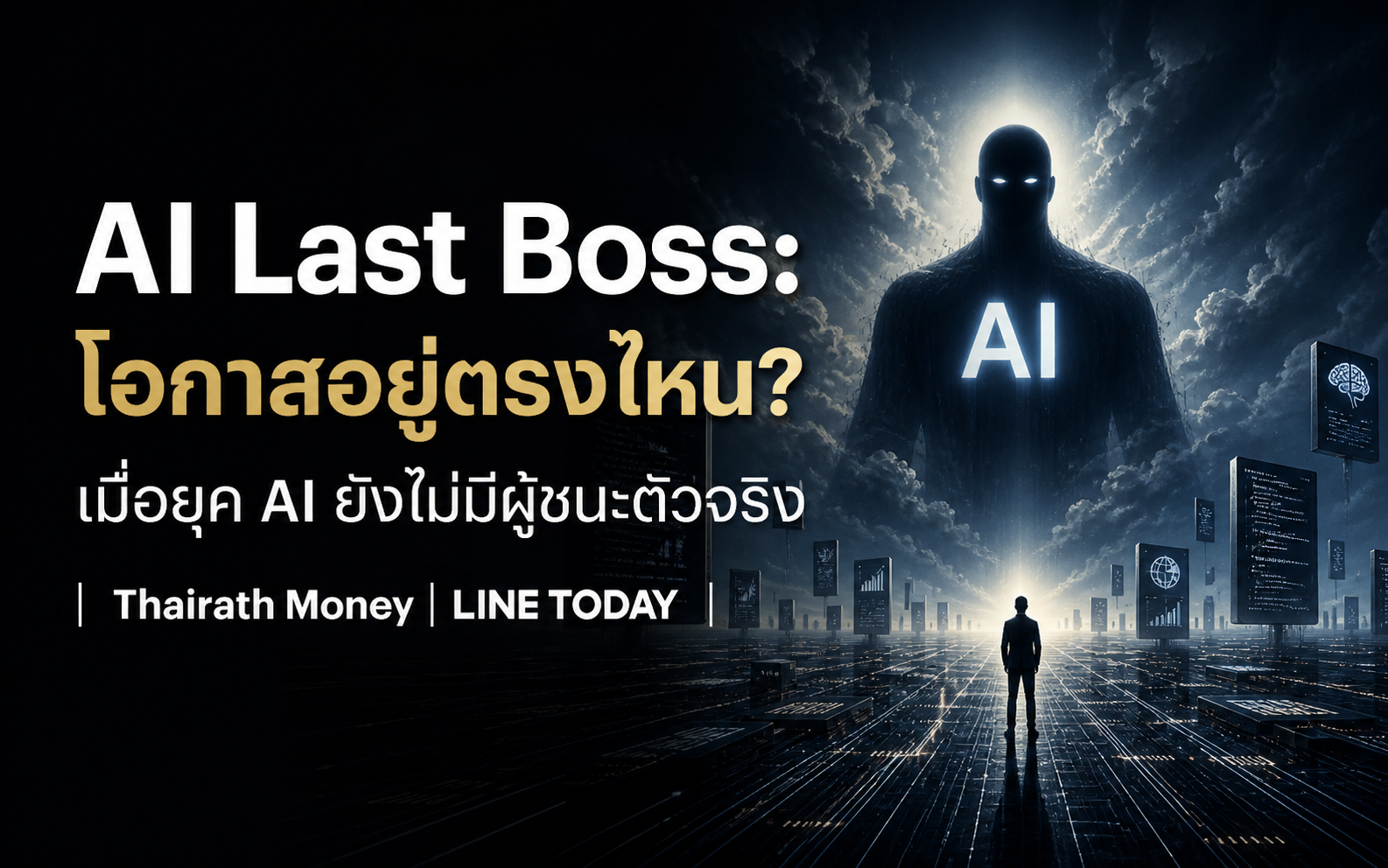
สรุปเวที “AI Last Boss” จาก MONEY FEST 2026 แปลงบทเรียนสู่คู่มือเข้าถึงการเรียนรู้ AI สำหรับนักศึกษาและสายเทค
เมื่อ AI ไม่ได้เป็นเพียงซอฟต์แวร์ แต่คือระบบนิเวศทั้งโครงสร้างพื้นฐาน โมเดล และการประยุกต์ใช้งาน สิ่งที่นักศึกษา วิศวกร ผู้ประกอบการ และนักลงทุนสายเทคต้องมองให้ทะลุ คือ “คอขวดที่ย้ายตำแหน่งตลอดเวลา” SPU รวบรวมสาระสำคัญจากเวที MONEY FEST 2026 หัวข้อ “AI Last Boss: โอกาสอยู่ตรงไหน? เมื่อยุค AI ยังไม่มีผู้ชนะตัวจริง” เพื่อเปิดทางการเข้าถึงองค์ความรู้แบบกระชับ เข้าใจง่าย และนำไปใช้ได้จริง
กรอบคิด AMI Framework วางชั้น I–Infrastructure (ชิป, HBM, Data Center, ระบบไฟฟ้า), M–Model (LLM ทั้งปิด–เปิด), และ A–Application (ซอฟต์แวร์องค์กร–ผู้ใช้ปลายทาง) ไว้อย่างเชื่อมโยง โดยสมการ A = M = I ชี้ชัดว่า ถ้าชั้นใดชะลอหรือสะดุด ระบบทั้งหมดสะดุดตาม เม็ดเงินลงทุนจึงไหลตาม “คอขวด” ที่ขยับอยู่เสมอ
คลื่นการลงทุน AI ที่ถูกถอดรหัสมี 3 ระลอกสำคัญ:
– Wave 1: Compute และ Semiconductor Monopolies—GPU, TSMC, ASML รับอานิสงส์จากการย้ายภาระงานจาก CPU สู่ GPU
– Wave 2: Memory Shift & MoE—เมื่อสถาปัตยกรรม Mixture of Experts ทำให้หน่วยความจำกลายเป็นคอขวด เงินทุนจึงไหลไป HBM (ผู้เล่นหลัก SK Hynix, Samsung, Micron)
– Next Wave: Power Grid & Smart Grid—เมื่อ HBM คลี่ตัว ข้อจำกัดไฟฟ้าและโครงข่ายอัจฉริยะจะเป็นสมรภูมิต่อไป
ในภาพใหญ่ฝั่งโครงสร้างพื้นฐานไฟฟ้า แนวคิด “Five-Layer Cake” เน้นว่าพลังงานคือฐานราก: ไฟฟ้าไหลเข้าชิป กลายเป็นโทเคน หากไฟฟ้าขาด แพลตฟอร์มล้ม สหรัฐฯ เดินแบบ organic จึงเสี่ยงแย่งใช้ไฟฟ้าระหว่าง Data Center กับชุมชน จีนผลักดันแบบ top-down สร้างเครือข่ายไฟฟ้าเกินความต้องการ ไทยมีกำลังผลิตรวมเพียงพอ แต่คอขวดอยู่ที่สายส่งเฉพาะพื้นที่ เช่น EEC
บนชั้นโมเดล มีสัญญาณเปลี่ยนเกม: การอ้างอิงข้อมูลจาก IDC คาด open model จะพุ่งสู่ 60% ในปีหน้า ขณะที่ closed model ลดเหลือ 40% โมเดลเปิดขนาดกลางรันบนเวิร์กสเตชันหรือ Mac Studio ได้ ให้ประสิทธิภาพกว่า 80% ของโมเดลท็อป ใช้ไฟน้อย ต้นทุนต่ำ ผลักดันแนวโน้มจาก Cloud สู่ On-Device AI อย่างมีนัยยะ
ชั้นแอปพลิเคชันสะท้อนภาพ “รวยกระจุก จนกระจาย” ผู้ขายชิป–อินฟราสตรักเจอร์ชนะ ขณะที่องค์กรส่วนใหญ่ยังขาดทุนจากค่า Token, ระบบ และวิศวกร แต่ยังมีผู้ชนะที่ชัดเจน: ซอฟต์แวร์องค์กรเดิม (Enterprise SaaS) ที่สอดไส้ AI เพื่อรักษาคูเมือง, ผู้ประกอบการเดี่ยว (One-Person Company) ที่ใช้ Sub-Agents สเกลงานแบบไร้ Legacy และ On-Device AI ที่ลดต้นทุน Cloud อย่างมีประสิทธิภาพ
ความเสี่ยงที่ต้องเฝ้าระวังคือการชะลอ CapEx ของ Hyperscalers, การทำเงินในชั้นแอปที่ยังไม่พิสูจน์ และคอขวดพลังงานไฟฟ้า ส่วนผู้ท้าชิง “Last Boss” ที่ถูกจับตา ได้แก่ Google (ฐานข้อมูล–Search–วิจัย), Apple (On-Device AI + กระแสเงินสด ไม่ต้องเผา CapEx โครงสร้างพื้นฐาน) และ Open-Source Ecosystem ที่กดต้นทุน Tokenomics และเร่งการเข้าถึงเทคโนโลยี
สำหรับสายเทคและนักศึกษา บทเรียนสำคัญคือ:
– มองโครงสร้างทั้งระบบ ไม่ไล่ตาม hype จุดเดียว
– ตัดสินใจเลือกโมเดล–สถาปัตยกรรมตามข้อจำกัด Compute/Memory/Power จริงของตน
– โฟกัส ROI เชิงระบบ: ต้นทุนพลังงาน–โทเคน–วิศวกรรม–กระบวนการ
– เตรียมทักษะ On-Device AI, ระบบกระจาย (distributed), และการออกแบบที่คำนึงถึงพลังงาน
SPU นำประเด็นเชิงโครงสร้างนี้มาสรุปแบบเข้าถึงง่าย เพื่อช่วยลดข้อจำกัดด้านการเรียนรู้ของนักศึกษาและชุมชนเทค ให้เข้าใจ A = M = I และจับจังหวะคลื่นถัดไปอย่างมีข้อมูลอ้างอิง แหล่งออริจินัล: เวที MONEY FEST 2026 “AI Last Boss” โดย Thairath Money
Distills “AI Last Boss” from MONEY FEST 2026 into an accessible playbook for students and tech professionals
AI today is not just software—it is an intertwined stack of infrastructure, models, and applications where bottlenecks keep migrating. SPU curates the key insights from the MONEY FEST 2026 panel “AI Last Boss: Where are the opportunities when no one has won yet?” to deliver a concise, accessible knowledge brief for students, engineers, founders, and tech investors.
The AMI Framework frames I–Infrastructure (chips, HBM, data centers, power), M–Models (open/closed LLMs), and A–Applications (enterprise/user-facing) as a single system. The A = M = I equation makes one thing clear: if any layer stalls, the whole system stumbles. Capital flows follow the moving bottleneck.
Three investment waves were decoded:
– Wave 1: Compute & Semiconductor Monopolies—Budget shifts from CPU to GPU lifted GPU designers, advanced fabs (TSMC), and EUV toolmakers (ASML).
– Wave 2: Memory Shift & MoE—Mixture of Experts pushes memory into bottleneck territory, sending capital to HBM (SK Hynix, Samsung, Micron).
– Next Wave: Power Grid & Smart Grid—As HBM pressure eases, electricity and grid constraints become the next frontier.
On power, the “Five-Layer Cake” view underscores that electricity is the foundation: power in, tokens out. Without it, the stack collapses. The US evolves organically and risks DC–community contention; China builds top-down with surplus capacity; Thailand’s total generation is sufficient but faces transmission bottlenecks in specific zones such as EEC.
Model dynamics may be a game-changer: IDC-referenced outlook suggests open models could reach 60% next year while closed models fall to 40%. Mid-sized open models running on workstations or Mac Studio can deliver 80%+ of top-tier performance with far lower power and cost, accelerating a shift from cloud to on-device AI.
In applications, the landscape is “profits concentrate, losses spread.” Chip/infrastructure vendors win while many enterprises still lose money after token, system, and engineering costs. Clear winners remain: entrenched Enterprise SaaS that embeds AI to defend moats, One-Person Companies scaling via Sub-Agents without legacy burdens, and On-Device AI that slashes cloud token costs.
Key risks to track: hyperscalers’ CapEx moderation, unproven monetization at the application layer, and electricity constraints. Potential “Last Boss” contenders include Google (data, search, deep research), Apple (on-device AI plus massive cash, avoiding infra CapEx burn), and the Open-Source ecosystem that compresses tokenomics and democratizes access.
For tech teams and students, the takeaways are:
– Think systemically across the stack—skip the hype, follow real bottlenecks.
– Choose models/architectures based on actual Compute/Memory/Power constraints.
– Manage ROI at system level: energy, tokens, engineering, and process.
– Skill up in on-device AI, distributed systems, and energy-aware design.
SPU’s accessible brief helps lower learning barriers for students and the tech community—clarifying A = M = I to ride the next AI waves with informed judgment. Original source: MONEY FEST 2026 “AI Last Boss” by Thairath Money.
ที่มา: