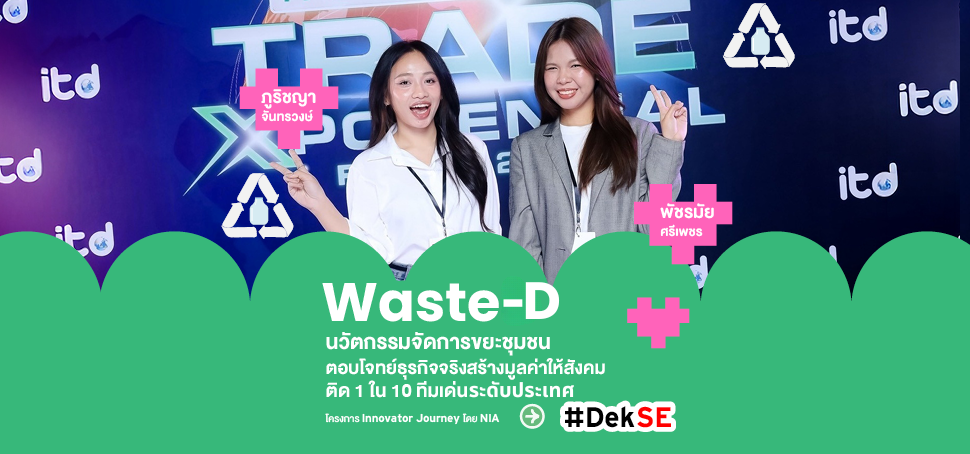
From seemingly worthless waste to economic and social opportunities, the Waste-D Ecosystem concept is not just a classroom project, but a business model that actively solves real-world community problems. This work by Phurichya Chantrawong and Patcharamai Sripech, students from the Faculty of Entrepreneurship at Sripatum University, reflects their potential to bridge the gap between learning and the business world, creating sustainable positive impact.
“We started with a simple question: Why are valuable wastes still being thrown away every day?” says Pang-Phurichaya Chantrawong, a student from the Faculty of Entrepreneurship at Sripatum University, explaining the starting point of Waste-D Ecosystem , a community waste management innovation that she and her team developed in collaboration with Get Digital Solution Co., Ltd. under the National Innovation Agency’s (NIA) Innovator Journey project.
This project wasn’t conceived on the spot, but stemmed from firsthand experience in the field. This led the team to discover that the waste problem isn’t just a matter of public awareness, but a systemic issue that hinders people’s willingness to take action.
The pain point that most people "want to do, but can't."
Through fieldwork and working with real users, the team found that the main problem with waste management is not a lack of intention, but rather limitations in daily life. Many people lack the time to sell their waste, while also lacking confidence in the pricing or transparency of the weighing process. Furthermore, most collection points are far away, resulting in significant time and travel expenses. In addition, a considerable number of people are unaware that their own waste can actually be turned into something valuable. These limitations result in a large amount of recyclable waste being discarded and losing its value, which is a great pity.
Turning “trash” into “income”.
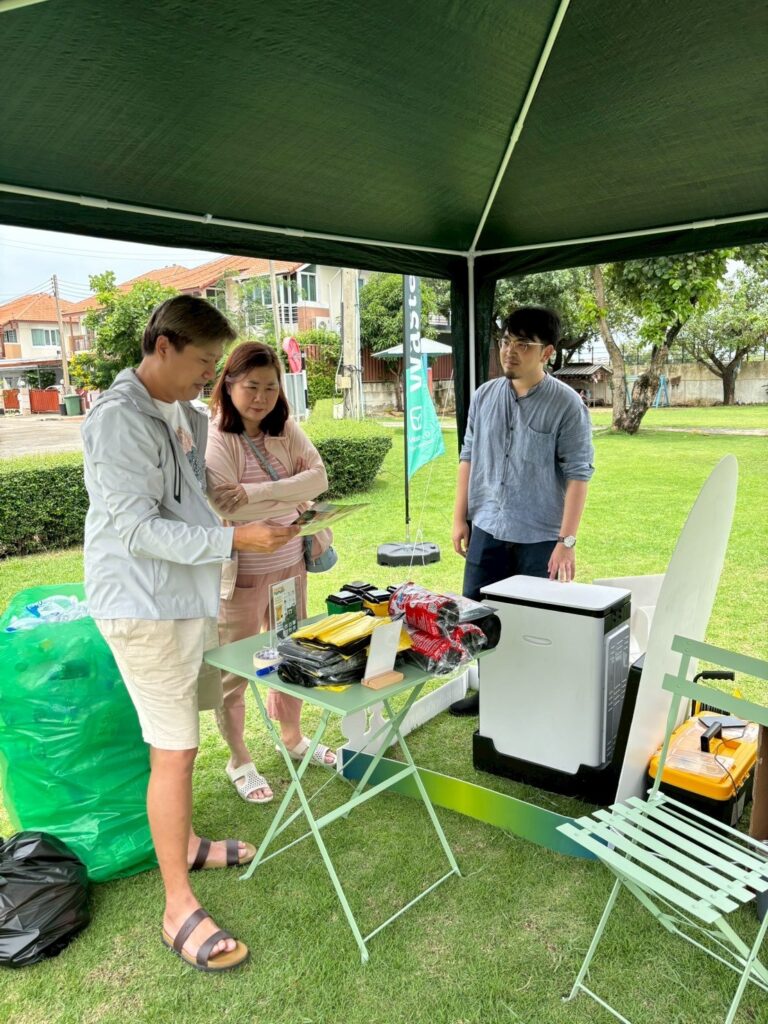
Waste-D is designed as a Waste-as-a-Service, a comprehensive waste management service that focuses on making selling waste easy for everyone in the community. The system allows users to access the service through LINE, a familiar platform in daily life, and offers home pickup service to reduce travel burdens and save time.
At the same time, the system also provides education on proper waste separation to improve the quality of recycled materials and creates incentives through real income coupled with a points accumulation system, making waste management not a distant concept but a practical activity that can be implemented in daily life.
The core concept of Waste-D is to design systems that inspire people to do it, rather than simply campaigning for them to do it—a significant shift from previous approaches.
From classroom project to a real-world business model.
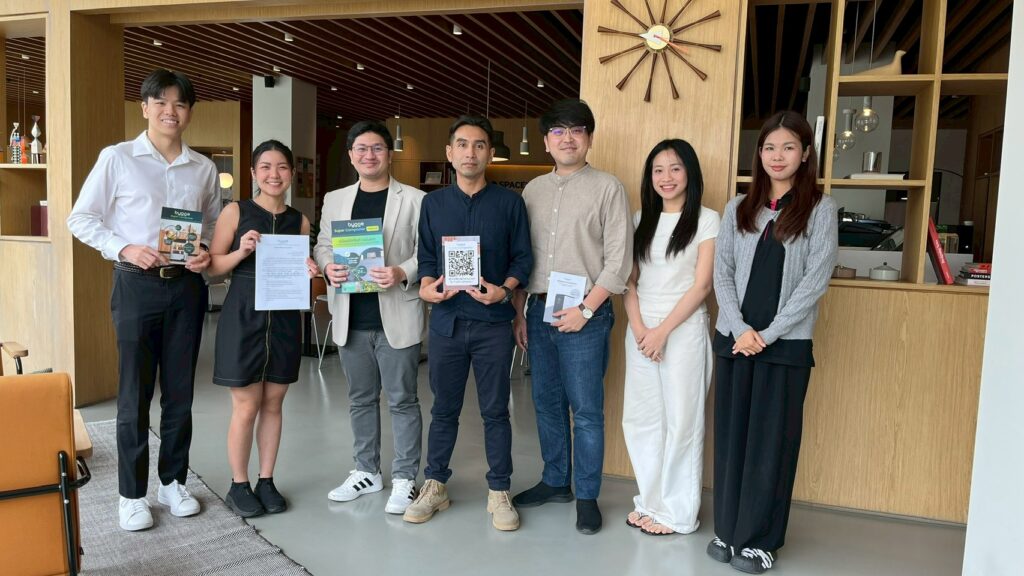
Working with real businesses taught the team that a good idea must be able to solve real-world problems, not just be a concept on paper. The Entrepreneurship program at Sripatum University therefore plays a crucial role in shaping students’ thinking processes, enabling them to look at problems deeply and ask questions to find realistic solutions.
Students actively utilized business tools, from customer analysis and business model design to collaborating with private sector partners, ensuring that Waste-D was not just a classroom project but a business prototype with the potential for future development and expansion.
When waste equals an opportunity for the community.
Waste-D doesn’t view waste as just a problem, but as a resource that can create value if the system facilitates proper management. When people can more easily sell their waste and earn income, their waste disposal habits will gradually change from throwing everything in one bin to intentionally sorting it.
This change will gradually expand from the household level to the community level, reducing the amount of waste that needs to be sent to landfills, while at the same time increasing the amount of recyclable materials returned to the system. Beyond the environmental benefits, Waste-D also creates social value by providing opportunities for people in the community, especially low-income groups, to generate income from their local resources and participate in driving change.
A good business must create "value," not just "profit."
The experience from developing Waste-D clearly showed Phurichaya that the role of business today should not be limited to profit generation, but can also be a key mechanism for solving social problems.
Sustainability, therefore, is not just a visual concept or a short-term campaign, but about designing systems that benefit all parties involved—users, communities, and the environment—simultaneously.
This perspective led her to believe that modern entrepreneurs should measure success based on “value created for society” alongside business results.
SPU: The place where "ideas" become "reality".
Waste-D’s success in securing a place among the top 10 outstanding teams nationwide in the NIA’s Innovator Journey project reflects not only the potential of the students but also the learning approach of Sripatum University, which provides students with opportunities to learn through hands-on experience.
Because in today’s world, good innovation is not just something that can be conceived, but something that can actually be used and create real change. And Waste-D is a clear example of transforming learning into truly valuable outcomes for society.
#SripatumUniversity #SPU #FacultyofEntrepreneurship #SPUExperiencedLearners #DEKSPU #showcase